Automating Loyalty with Card Linking Part 2: Enrollment

pos enroll at pos

As we discussed in my last post, there are three essential elements of loyalty; 1. Enrollment; 2 Engagement; and 3. Redemption. Today we discuss card linked enrollment for a merchant’s loyalty program.

There are two types of card linking loyalty options; terminal agnostic and terminal integration.  Terminal agnostic is 100% in the cloud and does not touch the terminal.  In fact that is a major benefit of terminal agnostic card linking.  The card brands, MasterCard and Visa are offering to marketing platforms, card linking solutions that integrate with loyalty solutions, like the BP card linking loyalty solution recently rolled out. But there is one drawback with terminal agnostic card linking; enrollment is too hard.

Convincing a shopper to go online and provide a credit card number for a single merchant’s loyalty program is hard. While an advocate of a major brand like BP may go online and enroll, the average customer for an average merchant is not. It is just too hard.

Another terminal agnostic card linking enrollment option is to first ask the customer to download a mobile phone loyalty app for the merchant’s loyalty program, and then if the app is downloaded, second ask the customer to set up an account in the app, and third, enter their credit card for the loyalty program.

The problem here is that the average smart phone user already has 26.7 apps on the cluttered phone. Remember share of wallet? Now there is a share of mobile phone screen space.  The app is probably not getting downloaded.  The other issue is that 70% of the total usage is coming from the top 200 apps. (Nielson   06-11-2015) What are the chances the customer will take the time to download the loyalty app just to link the credit card to the merchant’s loyalty program?  There is another way.

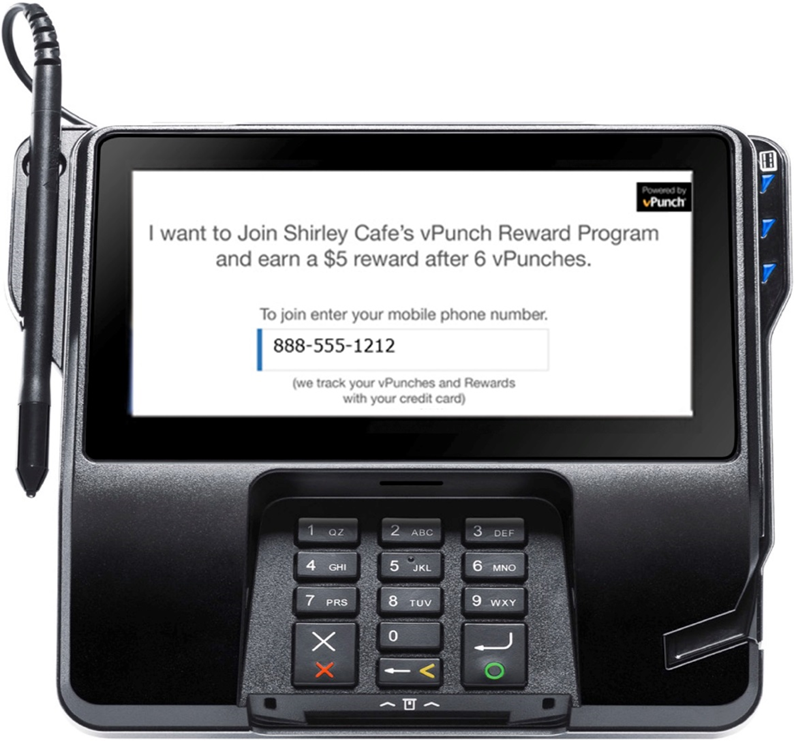
Terminal integrated card linking excels at enrollment, and here is why.  When the customer pays with a payment card, a card linking platform like vPromos in real time can see if the payment card token is in the loyalty program.  If not, a message like the one above is sent to the terminal, prompting the customer to provide a secondary unique loyalty identifier like a mobile number.

Before EMV, trying to integrate card linking with point of sale systems was hard. There were just too many POS systems to integrate with. And POS systems were notoriously unwilling to make it easy to integrate because of PCI requirements.

After EMV, the payments landscape is changing. Now most POS companies are no longer processing credit cards. That responsibility of credit card processing is left to the terminal companies. There are just a handful of terminal companies, and these companies are entering the card linking space.  For example, Verifone, the terminal leader in the US, is taking the lead in the terminal space with its Card Commerce initiative which will enable terminal integrated card linking. Terminal integrated card linking is about to take off in 2016.

What are your thoughts about how to take advantage of terminal integrated card linking?
Automating Loyalty with Card Linking Part 1

POS loyalty checkout

A loyalty program delivered smartly will attract new customers, turn customers into repeat customers, increase business, and deliver valuable business data and demographic intelligence. While the world today expects elegant solutions achieved through technology and automation, it’s clear that most of today’s loyalty solutions, are still reliant on manual execution. As a result, the loyalty process interrupts the payment process and is often prone to delivering a poor experience for both the customer and merchant.

We can do better. It is time for loyalty programs to enter the twenty first century and become automated. A merchant loyalty program linked to the customer’s payment card offers all parties an easy, seamless, automated, reliable and accurate loyalty solution.

There are typically three basic challenges with loyalty programs that every CMO wants to improve:

  1. Enrollment – Cashiers don’t always ask customers to enroll, and customers don’t always want to supply personal information to a stranger.
  2. Tracking – Again, the problem is that cashiers are not always asking for loyalty numbers or cards associated with loyalty.
  3. Redemption – Customers are not redeeming rewards as expected.  They say it is too hard to download rewards and remember to bring to the store.

The reality is that everyone, including your loyal customers want convenience in their busy lives. One company, British Petroleum (BP), is making it easy for their loyal customers to earn points and rewards.

BP just introduced its card linking loyalty solution at the gas pump. Historically, customers had to swipe their loyalty card or enter a 10 digit number. BP customers can now go online and link their payment card to the BP loyalty card.  

After linking the credit card, a BP customer earns points every time they pay.  No additional steps to take. To redeem the rewards, the BP customer simply pays, and the reward comes off on their linked credit card statement.  Today this only works with Visa, but it is still a huge convenience for BP customers.

Retailers need to make it easier for customers to enroll, track and redeem rewards. That means in addition to letting customers earn and redeem points by showing their loyalty card or providing their mobile number at checkout, we should let our customers earn and redeem rewards with their existing credit or debit card.

Loyalty Program Background and Challenges

Today, a loyalty tracking system is typically manual. This means every time a customer pays, the cashier must ask: “Are you in our reward program?”

This question must be asked every time because a manual loyalty tracking system has no way of knowing whether the customer is in the retailer’s respective loyalty program or not. If a customer is not a program member, the cashier is supposed to ask if the customer would like to join the loyalty program. But many customers prefer not to share their personal info with a cashier. While customers can go online to enroll, once a customer leaves the store, it is highly unlikely that they will enroll.

Typical industry loyalty tracking form factors include:

  • A mobile number to a cashier
  • A mobile phone bar code
  • Loyalty cards

These loyalty tracking systems are manual, and as a result, for the loyalty system to track, the cashier has to ask every time if the customer is in the retailer’s program. This is a tedious process that slows the line and can frustrate customers who previously declined to enroll. Moreover, all cashiers are not created equally. Untrained, inexperienced, shy, introverted and lazy cashiers simply may not ask. These inefficiencies negatively impact enrollment, data accuracy, loyalty points tracking and customer satisfaction.  

With regards to redemption, a fraction of the earned rewards are redeemed. Many members complain that it is too much trouble to print out a reward and bring it to the store.  While breakage may be considered good for certain coupons, it is a negative for loyalty.  

If you want to evaluate your own loyalty rewards gaps, consider the following questions:

How easy is your enrollment process?

How easy is tracking and redemption?

Could automation improve your loyalty program?

What percentage of your customers pay with credit cards?

A low adoption and engagement rate for loyalty programs may be remedied with innovation. I will cover further process and improvement ideas in my next article.

The ISO’s Special Realm

Transaction Trends is posting an article I published. You can find a direct link here or read the article below on my take with ISO’s as a strategic channel for card-linking.

cardreader

There was a time when ISOs sold magnetic-stripe “loyalty cards,” but demand for those loyalty cards appeared to wane. However, that falloff was not the result of reduced demand but rather poor execution: Customers just did not want to carry another loyalty card. Today, loyalty is in increasing demand, and loyalty provider startups are selling loyalty devices and apps directly to small to medium-sized businesses (SMBs), to the exclusion of ISOs. Thus, two questions arise: Why are ISOs no longer in the loyalty game, and is there an opportunity to get back in? While it appears that ISOs have ceded loyalty to the startups, in 2016 card brands, terminal companies, and Software as a Service (SaaS) loyalty providers are bringing to market terminal integrated card-linked loyalty solutions that vastly improve and streamline the customer loyalty experience for merchants and customers alike—and ISOs are the only ones that can sell them.

The terminal is the ISO’s special realm. If it touches the terminal/point of sale (going forward we will use “terminal” to reference both), the merchant is calling the ISO. If ISOs want to sell loyalty, loyalty must touch the terminal. It makes perfect sense for loyalty to be tracked at the terminal because shopping is the key metric.

According to Forrester Data’s recent “Forrester Wave: Customer Loyalty, Solutions for Midsize Organizations, Q1 2016” report, “Our data shows that improving customer loyalty is likely to be a top marketing priority for 80 percent of decision makers at midsize organizations in the next 12 months. As a result, they seek loyalty solutions that help companies identify and track customers, reward behavior, and drive deeper engagement and relationships.” The loyalty market is big, and SMBs will pay for it.

Who Wants to Download a Loyalty App?

The ISOs’ execution failure opened the SMB loyalty market to firms like Belly, which does not touch the terminal. Belly’s ($99 to $200 a month) product is a separate device that sits next to the terminal, taking up counter space, with the Belly brand standing between the merchant and customer. As with many other loyalty companies, Belly requires the merchant’s customer to download the Belly app to redeem the reward. Because these devices do not touch the payment terminal, the loyalty companies do not need ISOs to sell to the merchant. They sell direct.

Notwithstanding the attempts of the loyalty startups, there is still too much friction with existing loyalty offerings. In addition to not wanting to carry another loyalty card, most SMB customers will not go online and enroll, download an app, provide their mobile number every time they shop, or print a reward. Customers are lazy—and rightfully so. Earning points and redeeming rewards should be as easy as simply paying with the credit or debit card already in their wallets.

Terminal Integrated Card-Linked Loyalty

Terminal integrated card-linked loyalty offers both merchants and their customers a superior, seamless, and easy loyalty execution by tracking loyalty with the payment cards customers already possess. With card-linked loyalty, every time customers shop and pay with their credit or debit card, they automatically earn points and redeem. No longer does a customer have to carry a separate loyalty card, download an app, provide a number with every purchase, or print a reward. The payment terminal, in effect, becomes the loyalty terminal, displacing any third-party device crowding the counter space. Card-linked loyalty becomes part of the payment process—and just happens.

A merchant’s loyalty program should be for the merchant’s best customers, with the goals of being easy and automatic, and increasing spending and frequency. This means the card-linked loyalty solution must empower the merchant to enroll its own customers, and the loyalty reward must be redeemable only at that merchant’s store. To make this happen, the card-linked loyalty program must be integrated into the merchant’s payment terminal.

As mentioned above, the merchant must be able to enroll its own customers. The single best place to enroll members is at the merchant’s point of sale. Once customers leave the store, getting them to go online to enroll and provide a credit card is almost impossible. But if the card-linked loyalty program is integrated into the terminal, linking the customer’s payment card to the merchant’s loyalty program becomes as easy as entering a mobile phone number into the terminal, one time. By integrating with the terminal, the SaaS loyalty provider sees the payment card token in real time, and, if the token is not in the loyalty program, the SaaS provider delivers a prompt to the terminal to enroll the customer. Only if the terminal is integrated with the SaaS loyalty program is it possible for the enroll- ment prompt to occur. But once integrated, enrolling the merchant’s customers is easy.

Today, card-linked offers are being embraced by Facebook, Twitter, Microsoft, and credit card issuing banks in a coalition format. (To learn more about card linking, go to http://www.cardlinx.org). Presently, card-linked offers are not integrated into the terminal, and, as a result, the discount can only be put back on the credit card statement or in another currency (e.g., airline miles). If a merchant wants its own loyalty program (as opposed to a coalition), then the loyalty reward should be the merchant’s reward, only redeemable back at the merchant’s terminal. Requiring the reward be redeemable back at the merchant drives another visit back to the merchant, which should be the goal of every loyalty program. With terminal integrated card-linked loyalty, when the customer pays with the enrolled card, the reward is automatically deducted from the total bill and reflected on the terminal printed receipt. It is a seamless and easy experience for the loyalty member and the merchant.

Terminal integrated card-linked loyalty automates the loyalty process, and it is the easiest and best merchant-centric loyalty solution in the marketplace. And there is only one industry that should sell it: ISOs.

Who Better To Sell Than ISOs?

SaaS companies, card brands, and terminal companies are or will be offering terminal integrated card-linked loyalty in 2016, and the ISO is the channel that should sell it. In addition to offering a complementary loyalty revenue stream, ISOs will sell terminal integrated card-linked loyalty to reduce churn. Merchants that have thousands of members in their terminal integrated loyalty program will not want to switch payment processor/loyalty providers.

Because card-linked loyalty touches the payment terminal, the exclusive realm of the ISO, the ISO is the logical sales channels for reselling terminal integrated card-linked loyalty. Welcome back to the Loyalty Game.

Will My Loyalty App Stick?

too many apps

Today, the average household has joined 29 loyalty programs, but only actively participates in 12.  Some merchants are going the mobile phone loyalty app route.  But consider that there are over 1.5 million apps out there.  Mobile users only download really important, relevant apps.  On average that is 20-50 apps per phone.  And users delete unused apps. With these hurdles, how does a smaller, less known or less frequented business get into loyalty without being one of the 17 abandoned loyalty programs or deleted apps?

The key to starting any loyalty program is enrolling members. If it is too hard, they won’t enroll. Asking customers to download an app for any merchant other that Starbucks or Walgreens is asking a lot.  Maybe early adopters will hurdle the obstacle.  But what about the other 90% of the customers who want to be loyal, but are unwilling to make the effort to download?

And once enrolled, declining engagement is a serious problem for loyalty programs.  Does that customer really want to take 4 steps to earn points?

  1. Pay, then
  2. Pull out phone
  3. Open the merchant’s loyalty app
  4. Show the mobile loyalty app to the clerk or scan it

That is a lot of work! If earning points and redemption is too hard, the app is getting deleted.

There is a better way . . . linking the customer’s own payment card to the merchant’s loyalty program. Loyalty should be part of simply paying. Every time a customer pays with the customer’s own credit or debit card, they should earn points for that merchant’s loyalty program.  Redeeming the merchant reward should be as simple as paying normally with the enrolled credit card.

It has to be easy. That means no app.  That is card linked loyalty.