Category: Marketing

Will My Loyalty App Stick?

too many apps

Today, the average household has joined 29 loyalty programs, but only actively participates in 12.  Some merchants are going the mobile phone loyalty app route.  But consider that there are over 1.5 million apps out there.  Mobile users only download really important, relevant apps.  On average that is 20-50 apps per phone.  And users delete unused apps. With these hurdles, how does a smaller, less known or less frequented business get into loyalty without being one of the 17 abandoned loyalty programs or deleted apps?

The key to starting any loyalty program is enrolling members. If it is too hard, they won’t enroll. Asking customers to download an app for any merchant other that Starbucks or Walgreens is asking a lot.  Maybe early adopters will hurdle the obstacle.  But what about the other 90% of the customers who want to be loyal, but are unwilling to make the effort to download?

And once enrolled, declining engagement is a serious problem for loyalty programs.  Does that customer really want to take 4 steps to earn points?

  1. Pay, then
  2. Pull out phone
  3. Open the merchant’s loyalty app
  4. Show the mobile loyalty app to the clerk or scan it

That is a lot of work! If earning points and redemption is too hard, the app is getting deleted.

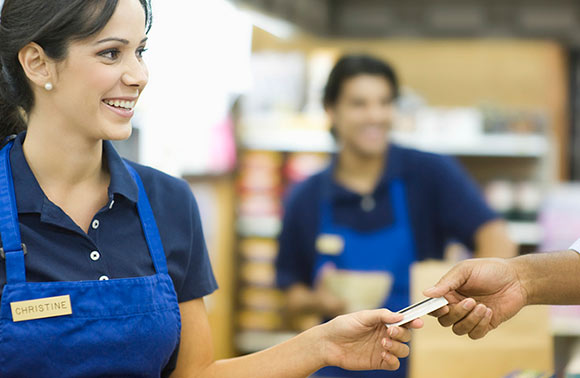
There is a better way . . . linking the customer’s own payment card to the merchant’s loyalty program. Loyalty should be part of simply paying. Every time a customer pays with the customer’s own credit or debit card, they should earn points for that merchant’s loyalty program.  Redeeming the merchant reward should be as simple as paying normally with the enrolled credit card.

It has to be easy. That means no app.  That is card linked loyalty.

Buy from ISOs

If you have read my blogs, you will notice a bias towards real time card linked promotions and loyalty versus delayed card linked promotions.  As a refresher, delayed card linked promotions put the rewards back on the credit card statement or in some form of cash back or airline points model. That is very 1990s.  The future of card linked offers I believe is real time, which enables the consumer to enroll right at the point of sale, receive real time text or email acknowledgment of points earned, and significantly, automatically redeem the reward back at the same merchant where the points were earned.

For delayed card linked offers, assuming a sale can be made to the merchant to market with delayed card linked offers, enabling the merchant to accept delayed card linked offers is not hard.  All that has to happen is that the merchant needs to sign a contract authorizing his merchant credit card bank to share the data with the matching company, which then shares matches with the marketing company. This means any company can really do this.  The barrier to entry is pretty small.  The benefit to the merchant is smaller still as addressed in my previous blogs.

For real time card linked offers and loyalty, the barrier to entry is much higher.  Real time is harder to implement because it’s integrated into the credit card terminal or the point of sale system (“POS”).  The terminal or point of sale system must do three things.  First, it must redirect the transaction amount to a gateway, which then relays the transaction data back into the data stream.  Second the terminal or POS must be able to allow for registration at the point of sale. And third it must be able to print out the receipt showing points earned or reward redeemed.  If the POS is involved, it has to account for the redeemed offer or reward discount.

There are two channels or industries that make sense for reselling real time card linked; the merchant acquiring independent sales organizations (“ISO”) sales channel and POS companies.  Terminal companies use the ISO sales channel to resell their product as do many POS companies.  Larger POS companies have their own direct sales teams and network of resellers.  Marketing companies are not going to be able to resell real time card linked promotions and loyalty because of the integration requirements described above. This is good for the ISO industry mired in commodity pricing, and looking for the next big thing.

ISOs today are looking for products to compete with the likes of Belly, Level Up, and other loyalty companies that do not touch the payment stream.  As discussed in previous blogs, Real time Card Linked loyalty and promotions require no additional steps to earn points or redeem rewards. Simply pay with the enrolled credit or debit card, and loyalty happens.

The ISO is the perfect party to resell real time card linked promotions and loyalty to the merchant.  2014 is going to be the year of the real time card linked promotions and loyalty.  Stay tuned.

The Makings of an Industry: Card-Linked Offers – Part 1

The Makings of an Industry: Card-Linked Offers | by Jeff Mankoff

Card-linked offers may seem like a relatively new development – a breakthrough very much still in the making – and it is. But the industry as we understand it today, is also the slow maturity of more than two decades of market testing and iteration. In Part 1 of a two-part series, we explore the very recent history of card-linked offers as we know them today.

Hello World 2.0: Card-Linked Offers

2010 saw the rise of Card-Linked Offers, as a distinct marketing segment unique from, and very much intent on superseding, both the declining daily deals phenomenon, as well as conventional loyalty marketing schemes such as reward cards and coupons. To that effect, expansion of the field has positively exploded. 2011 saw a flood of startups and established industry giants alike rush into the field in a series of uncoordinated first attempts at cornering the card-linked offer market before it even crystalized.

American Express Company (AXP), the largest credit card issuer by purchases, began delivering customized discounts and offers to cardholders who opted into the program. In return, participating cardholders allowed AmEx to mine their personal Facebook data.

At the time, this drive for online integration and data collection in return for rewards was largely informed by the rise of mobile and online payments, and the apparent success of e-coupon purveyors such as Groupon. With continual iteration, and the sensational but completely understandable implosion of Groupon’s daily deals model in recent times, the doors have swung wide open for card-linked offers to enter the mainstream.

In October of this year, many of the movers and shakers of the e-commerce, payments, banking, and social media sectors formally formed The CardLinx Association, an interoperability organization promoting the adoption and expansion of card-linked offers. Industry giants, including Microsoft, Facebook, Bank of America, Mastercard, and LivingSocial, just to name a few, see card-linked offers as a keystone of the new consumer experience.

Industry experts have projected earnings from the real-time, locations-based deals sector to surpass 4 billion by 2015. In 2010, that number was just 815 million. But in many ways, so-called static or delayed card-linked offers have existed as a viable marketing strategy for some decades now.

Today’s consolidated systems, in which a single consumer credit or debit card is linked to all manner of personalized discounts, deals, and promotions, is only a degree removed from the relatively simplistic, and already widely adopted, rewards cards issued by banks and other financial institutions. These often points-based systems are, in turn, not so removed from the simplest proprietary rewards cards offered by retailers, grocery chains, and airlines. That means that, from an evolutionary standpoint, the story of card-linked offers begins in the 1980’s.

Join us next week as we dive into the frequent flier programs of the 1980’s (the granddaddy of loyalty programs) and the delayed card-linked systems (think rewards credit cards) of the 1990’s that we still use today. More importantly, we will look at some of the differences between the delayed and proprietary card-linked rewards programs popular today and the rapidly crystallizing real-time card-linked offers sector.

Card-Linked Offers Mean No Hassles

Card-Linked Offers and Small Business | Jeff Mankoff

How and why card-linked offers are poised to boost the earning potential of businesses across the nation.

The Daily Deals (Re)Model

It’s no secret. Consumers and merchants alike have lost their enthusiasm for Daily Deals a la Groupon, Living Social, and a million other copy-cat e-coupon peddlers. To the discerning eyes of the general public, once the novelty of getting “half-off French cuisine” wore off, many of these email-based platforms began looking suspiciously similar to spam. On the merchant side, the initial promise of daily deals either never materialized, or manifested itself in a new set of insurmountable challenges – such as an incredibly lopsided merchant agreement which gobbled up most of a local merchant’s profits while saddling them with all the risks.

Even worse, many establishments who did manage to run a successful deal campaign through the e-coupon platform soon found that the deal-seeking crowds immediately disappeared after the deals ran their course. As it turns out, cut-rate price promotions don’t engender loyalty at all. This effectively left partnering merchants back at square one, or for an unlucky few, utterly ruined financially.

The daily deals financial model is, in its current configuration, probably not business-friendly. More accurately, it is just a remodel, a re-skinning of the age-old practice of showering consumers with coupons – hardly the lauded cure for the marketing woes of a business.

The Card-linked Offers Model

In lieu of these revelations, what is a business to do? In truth, there is no silver bullet fix for low customer engagement, faltering consumer loyalty, or lack of general enthusiasm. Ultimately, the ideal solution is to build a better product, improve customer service, and design a superior customer experience. Groupon and its many imitators failed to add value on all three critical fronts, relying exclusively instead on aggressive price slashing.

Card-linked offers, in contrast, take the idea of ecommerce integration a step in the right direction. The real strength of card-linked systems, and Groupon’s greatest failure, lay in its potential as an engagement tool.

In Groupon’s case, when it came down to it, it was still all about hawking coupons. The only difference was that the act of salesmanship received a technology-appropriate upgrade in the form of a slick website and a well-developed email-farming apparatus. The cultivation of actual customer loyalty was left unaddressed.

Card-linked systems aim to dig much deeper and develop what some call a sustainable business ecosystem, within which consumers, local merchants, and financial institutions all mutually benefit.

The benefits for financial institutions and banks are obvious – more card usage. But, both consumers and merchants also benefit greatly within a card-linked ecosystem. Consumers skip the need to print and cut out coupon promotions and mail-in-rebates, and receive rewards as an easy-to-decipher percentage of their total spending.

No confusion about stacking deals. No worrying about expiration dates. No hassles.

Better yet, deals are individually targeted and directly linked to a credit or debit card, drastically reducing unwanted email inbox filler and frantic check-out counter searching for lost coupons. Merchants benefit from the expanded reach offered by credit card companies. More importantly, pairing promotions directly with specific credit cards effectively allows merchants to “borrow” consumer loyalty from the card providers.

Merchants also gain easy-to-parse, and highly valuable, consumer purchasing histories, which can help inform increasingly effective and individualized promotions consumers will actually act on. All this is to say that card-linked systems are poised to become an entirely new integrated engagement platform, rather than just the reformulation of an old strategy.

For businesses, this could be a transformative development that has the potential to tie all the disparate pieces of conventional marketing practice into simple, unified architecture. As card-linked offers gain wider acceptance, they will eventually become as commonplace as punch cards and membership cards are today. By leveraging a host of equalizing technologies, such as social media and card-linked offers, retailers and business outfits stand a real chance of competing on a wider scale than ever before.

For businesses looking for a way to implement real-time offers to their best customers vPromos can help.